With the quantitative explosion of digital data production, researchers have been led to find new ways of seeing, but also of analyzing the world. It was a matter of being able to discover new orders of magnitude, which concerned both capture, search, sharing, storage, analysis, and data presentation. This is in this dynamic that « Big Data » appeared.
The Big Data – megadata or massive data – designates the set of digital data produced by the use of new technologies for personal or professional purposes.
This set, which no classical database management or information management tool can really work with, brings together the data produced by companies (emails, documents, databases, etc.), those from sensors, of content published on the web (images, videos, sounds, texts), of transactions (e-commerce, etc.), of the exchanges on social networks. We also find there the data transmitted by connected objects or even geolocated data.
Although no precise or universal definition can be given to Big Data, because it is a polymorphic complex object, it is possible to see it as a concept allowing to store a very large, even innumerable, quantity of data on a digital basis, accessible by all in real time.;
According to the 2018; Association for Computing Machinery, the expression "Big Data" appeared for the first time in 1997, in scientific articles treating technological definitions to make visible the large datasets of data.
The rule of the 3 Vs
In 2001, the analyst of the cabinet Gartner, Doug Laney described Big Data as a family of tools responding to a triple problem, called the rule of the 3V:
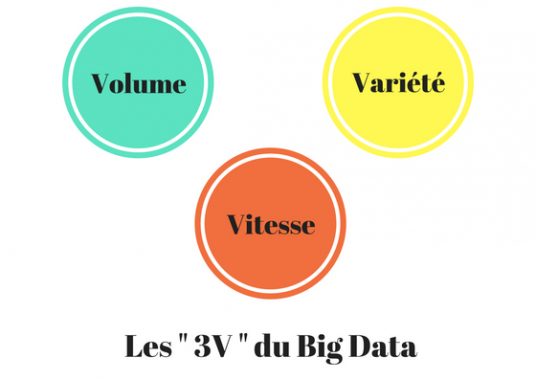
- the Volume of data to process, more and more massive,;
- the Variety of these data, which can be raw, unstructured or semi-structured,and from various sources,;
- the Velocity, which designates the fact that these data are produced, collected and analyzed in real time.
Some companies add a fourth "V" to this definition, for Veracity, which evokes the necessity of verifying the credibility of the source and the quality of the content, in order to be able to exploit these data.
Application examples
The exploitation of Big Data has opened of new perspectives in numerous domains. Here are some examples:
Marketing
The massive collection of customer data, associated with the analysis of these, offers numerous opportunities to the marketing services of companies. To better understand the target audiences, it is necessary to deeply understand their behaviors and their specific needs. This in-depth knowledge then makes it possible to improve the performance of marketing campaigns, whether it involves emails, retargeting or lead nurturing strategies. By personalizing the user experience on a website according to individual preferences, it is possible to create more engaging and relevant interactions. Moreover, by optimizing loyalty and strengthening the customer relationship, it is possible to promote long-term retention. Finally, the use of predictive analysis makes it possible to anticipate future trends, thus offering a competitive advantage and a capacity to quickly adapt to market evolutions.
Finance
In the financial sector, the emergence of Big Data has catalyzed various forms of innovation, such as the improvement of the detection of payment card frauds, the mutualization of data between banks, the use of "sentiment" analysis of investors to guide the actions of traders, the establishment of scores to evaluate the credit requests, as well as the development of loan platforms in "peer-to-peer".
Health
Thanks to the set of sociodemographic and health data, available from different sources that collect them (medical imaging devices or even pathology processing devices), via computers, the use of Big Data today allows the identification of disease risk factors, aid to diagnosis, the choice and the monitoring of treatment effectiveness. This suggests that we could improve our quality of life, because the health sector would become more efficient.
The study of massive data also facilitates the conduct of epidemiological studies on diseases within the population, as this was the case during the COVID-19 epidemic.
How to train in Big Data?
Big Data is considered as one of the greatest IT definitions currently. More and more companies are looking for people capable of analyzing and managing the quantities of data generated by the activities on their networks. It therefore becomes indispensable to adapt to the imminent needs of the market by acquiring solid skills in Big Data.
To be able to train in Big Data, it is often recommended to initially orient towards general IT training or information systems, such as BTS or the Licenses, in order to obtain the basics in computer science. Specialization in Big Data generally happens after this stage.
At this stage, several options are possible such as:- The continuous training in certified training centers
- Schools and universities offering masters and degrees recognized by the State
- The certified professional trainings
- The engineering schools
- Certain business/management schools
To be able to acquire solid knowledge and skills in this area, with the aim of making it your profession, it is preferable to avoid tutorials or training over a few days, which only allow to be initiated to "Big Data."
A solid training in Big Data must address both theory and the practical aspect of this science, and be provided, ideally, by experts, who not only teach Big Data but also exploit it in real projects. Thus, it will always be preferable to value diploma trainings, certified, and delivered by professionals and experts in the sector.