Data Mining or data exploration corresponds to a set of tools, automatic or semi-automatic, used for extracting and analyzing a large amount of data, contained in a database, in order to transform them into useful information. These pieces of information are assembled to constitute models or patterns usable by algorithms.
Data Mining relies on various algorithms that allow segmenting data and evaluating future probabilities, such as market trends for a company.
The processed data can be of 3 types:
- Operational or transactional data, such as data related to sales, costs, inventories, accounting, etc.
- Non-operational data, which can be forecast data or macro-economic data.
- Metadata, which corresponds to the data of the data themselves.
This data analysis method favors the emergence of technologies such as artificial intelligence, machine learning or complex probability models.
Varieties of Data Mining
There are 5 varieties of Data Mining:
- Association, which consists of detecting new models or patterns in which an event is linked to another;
- Sequence analysis, which corresponds to the search for patterns or models in which an event leads to another event;
- Classification, which consists of searching for and detecting new patterns or models, changing if necessary the organization of data;
- Clustering, which visually groups data by similarity in classes that are not known;
- Prediction, also called predictive analysis, allows the discovery of data patterns or models that can lead to possible predictions in the future.
How Data Mining Works
Data exploration derives from Machine Learning which gives computers the ability to learn without being explicitly programmed to.
Data Mining is a series of ordered operations that allow to reach a final result.
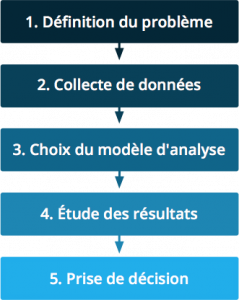
- The definition of the problem: this step will allow to define the objectives of the project as well as the constraints associated with it or that may be encountered.
- Data collection: this corresponds to collection, evaluation and selection of data that will be used. This phase therefore implies data preparation, from raw data, to keep only "clean" and consolidated data, that is to say usable data.
- The choice of analysis model: it is during this phase that the modeling techniques to be used will be selected and parameterized.
- The study of results: it allows to evaluate the quality as well as the relevance of the results obtained, with regard to the objective that has been defined beforehand.
- Decision making: based on the results obtained, data will allow decision making.
Modeling techniques are to be chosen according to the nature of the data that will be used, but also according to the type of study that one wishes to conduct, with regard to the defined objective.
There are three types of modeling: supervised modeling, unsupervised modeling and data reduction modeling.
Application Examples
The use of Data Mining has opened new perspectives in many fields. Here are some examples:
Marketing
Marketing and web marketing are sectors of predilection concerning the use of "Data Mining". It will allow to better understand customer behavior and their needs. This in order to adapt offers and marketing actions according to their profiles, but also to predict their future needs.
Human Resources
Data Mining can be used in human resources to identify the characteristics of the most efficient employees. The information obtained can contribute to improving recruitment processes.
Banking
In the banking sector, Data Mining allows to detect credit card fraud, to help manage the risk related to granting bank loans by scoring, to detect stock market behavior rules, through market data analysis or to discover hidden relationships between financial indicators.
How to train in Data Mining?
Companies generate and collect more and more data, which they need to analyze in order to draw conclusions and make good decisions. And this trend will only increase in the coming years. Indeed, more and more companies are seeking to invest in decision support solutions, such as Data Mining.
They wish to be surrounded by people capable of analyzing their data in order to evaluate future probabilities and therefore help in decision making. Thus, skills in this area will become increasingly sought after by companies. Therefore, it becomes essential to adapt to the immediate needs of the market by acquiring solid skills in Data Mining.
If you are interested in the "Data Mining" process and wish to make it your specialty, you can notably turn to:
- Continuous training in certified training centers
- Schools and universities offering masters and degrees recognized by the State
- certified professional training
- engineering schools
- Certain business/management schools
To be able to acquire solid knowledge and skills in this area, with the aim of making it your profession, it is preferable to avoid tutorials or training over a few days, which only allow to be initiated to "Data Mining."
A solid training in Data Mining must address both theory and the practical aspect of this science, and be provided, ideally, by experts, who not only teach Data Mining but also exploit it in real projects. Thus, it will always be preferable to value diploma trainings, certified, and delivered by professionals and experts in the sector.